
Baseline Surveys at Spring Creek Farms
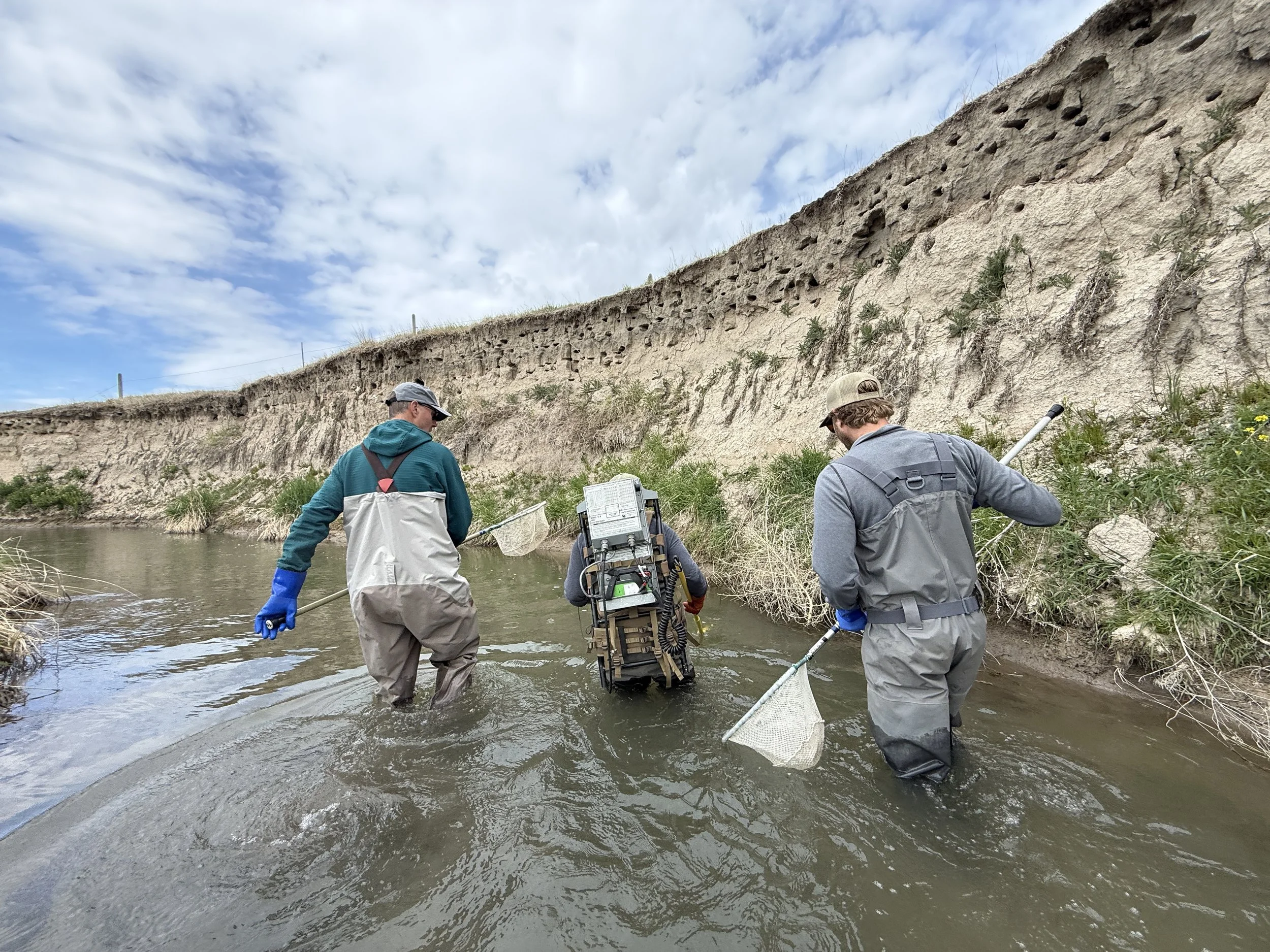
The field crew out for a day of electrofishing on Camp Creek.
One late-May morning, four guys with nets, buckets, waders, and a battery pack waded into a creek. What happened next will shock you (and about 150 fish).
Spring Creek Farms is the site of what will be the Gallatin Watershed Council’s largest restoration project to date. Before we break ground, however, it is important to document the current ecological conditions so we can assess how things change. So, on that mild-weathered May morning, Jared and I from the watershed council were joined by two biologists from Montana Fish, Wildlife and Parks to survey the baseline fish population in a 1.3-mile stretch of Camp Creek.
We looked like we were on our way to bust some ghosts, but our targets were very much alive. The four of us trekked upstream behind FWP’s Keith Wellstone, who carried the heavy-duty backpack unit, scanning back and forth with a wand-mounted anode in one hand and a cathode cable trailing behind. A pulsed, low-voltage current passed between the two, creating an electric field that drew fish involuntarily toward it. We followed close behind in rubber waders and gloves, dip nets at the ready, scooping up the temporarily stunned fish as they floated to the surface around us.
The fish recovered almost immediately, but rode along with us in aerated live wells for the rest of the walk. Above us, the creek’s steep, incised bank rose 15 feet in places, and the farm manager kept pace along its edge, chatting with the crew, taking photos, and managing to catch every fumbled net-to-bucket transfer on film.
Once we climbed out of the stream, each fish was identified, measured, and weighed. Rainbow trout made up the majority of our Camp Creek census, followed by mountain whitefish, a handful of longnose dace, and a couple of Rocky Mountain sculpin - a fish I’d never seen up close before, and an unexpected thrill for something so small.
Every fish went back into the creek and darted off quickly, disappearing into water that, for now, still runs along steep eroded banks. Once Camp Creek is reconnected to its floodplain and its banks are thick with willows and other native riparian vegetation, we’ll come back with the same gear and see just how much shifts beneath the surface. Perhaps we’ll be the shocked ones then.
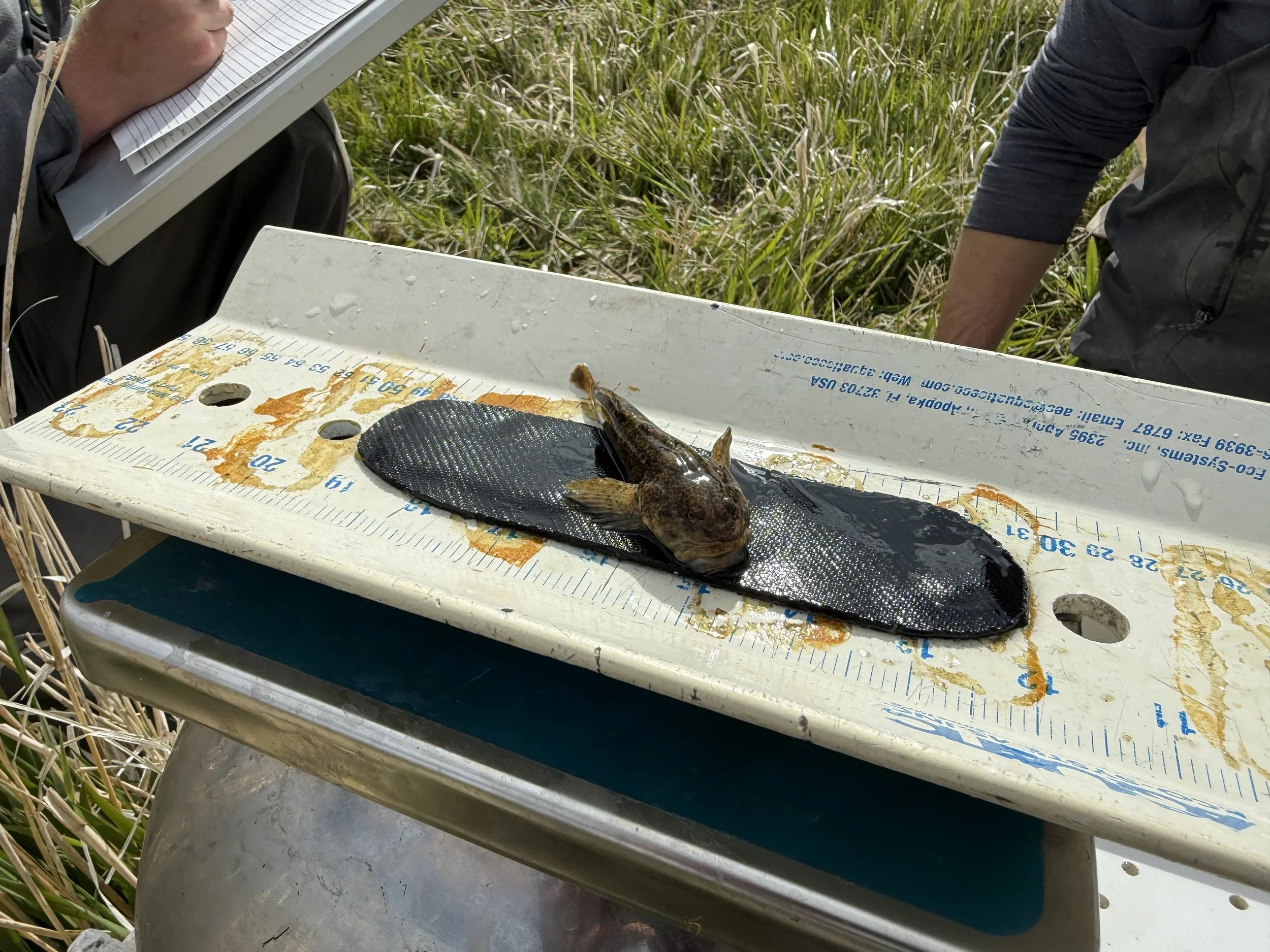
A Rocky Mountain sculpin being measured and weighed
Written by Ben Buescher